
Latest
News
Plastic Modular Pontoons vs Steel Modular Pontoons – Which Is Right for Your Project?
Plastic Modular Pontoons vs Steel Modular Pontoons – Which Is Right for Your Project?
At National Pontoon, one of the most common questions we’re asked by clients is:
“Should we use plastic modular pontoons or steel modular pontoons for our site?”
The answer depends entirely on the nature of your project — including the load capacity required, environmental conditions, installation site, and duration of use. We supply and install both types of pontoons across the UK, which gives us a unique, unbiased perspective on what works best for different scenarios.
This article explores the key differences between plastic and steel modular pontoons to help you make an informed decision.
Understanding the Basics
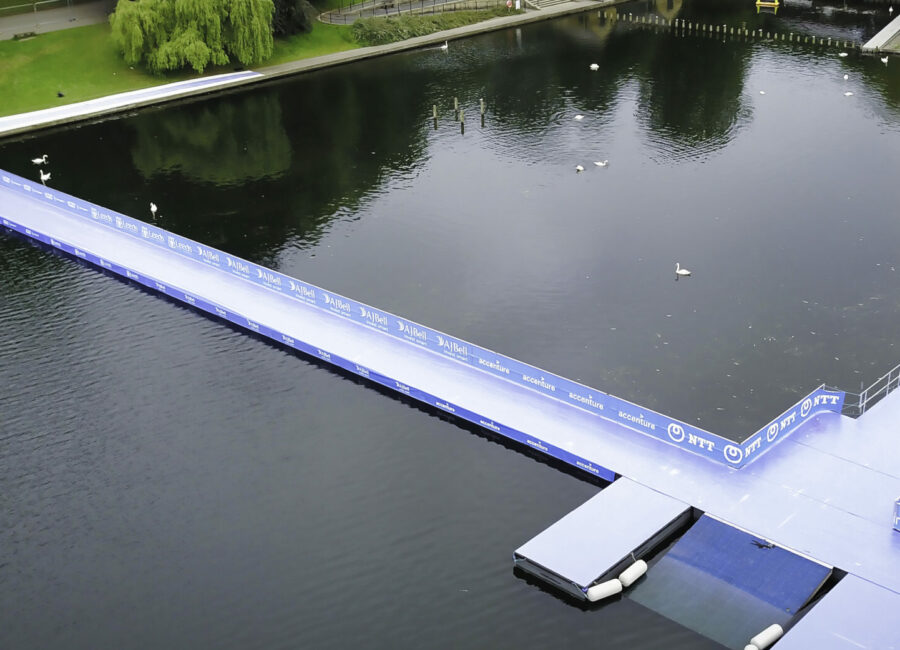
Plastic modular pontoons are typically made from high-density polyethylene (HDPE). These interlocking cubes are lightweight, adaptable, and ideal for temporary installations. Because of their modularity, they can be configured into a wide variety of shapes and sizes — making them suitable for pedestrian walkways, leisure access, or floating stages.
In contrast, steel modular pontoons (such as our NATO-type systems) are built for strength. Fabricated using marine-grade galvanised or painted steel, they are engineered to support heavy-duty applications. These units are commonly used in construction, civil engineering, and marine infrastructure projects, where durability and structural integrity are non-negotiable.
Strength and Load Capacity
When it comes to supporting weight, steel pontoons clearly outperform. They are capable of handling significant live loads — including excavators, scaffolding towers, generators, and vehicles. Typical capacities range from 300–500 kg per square metre or more, making them ideal for demanding sites such as bridge repairs or flood defence work.
Plastic pontoons, while stable, are more suitable for lightweight applications. Load capacities generally fall between 80–200 kg per square metre, depending on the configuration. They’re excellent for floating platforms at festivals, temporary walkways, jet ski docks, or marinas.
So, if you’re planning to transport heavy equipment or machinery, steel is the way forward. But for short-term events or water access projects, plastic pontoons may be more cost-effective and easier to deploy.
Deployment and Logistics
Plastic pontoons are designed with rapid installation in mind. Lightweight enough to be carried by hand, they can be assembled and dismantled without the need for heavy plant. This makes them perfect for remote locations, or where vehicle access is restricted.
Steel pontoons, on the other hand, require telehandlers, cranes, or Hiab vehicles to move into place. Although heavier and more logistically complex, they can still be installed and removed quickly by experienced marine teams — especially when working in conjunction with our support boats and on-site logistics team.
If you’re working in a remote area with minimal access — like our recent project in Loch Shiel, Scotland, where we transported heavy plant machinery across the water to a remote site — a combination of steel pontoons and robust planning can ensure seamless delivery. You can read more about that operation here.
Durability and Maintenance
Plastic pontoons require very little maintenance. They’re UV-stable, corrosion-free, and do not degrade in freshwater environments. However, they can be vulnerable to cracking or damage when exposed to impact from large objects or equipment.
Steel pontoons are built to last — often for decades — provided they are maintained properly. With appropriate marine-grade coatings and periodic inspections, they are capable of withstanding tidal changes, wave impact, and rough site conditions.
Ultimately, steel pontoons offer the best long-term resilience, especially for infrastructure projects that extend over many months or years.
Environmental Impact
Both systems can be sustainable when deployed and maintained responsibly. Plastic pontoons are fully recyclable and, when correctly managed, do not release microplastics into the environment.
Steel pontoons can be reused across multiple projects and are also 100% recyclable at the end of their lifespan. At National Pontoon, we prioritise sustainable sourcing, minimal transport miles, and reuse strategies to reduce our environmental footprint.
Typical Use Cases and Industry Examples
- For bridge construction, civil engineering, or marine infrastructure, steel pontoons provide unmatched stability and load-bearing capacity.
- For floating events, such as music festivals or film sets, both systems can be used — depending on what needs to be supported.
- In flood response, emergency access, or coastal pathways, plastic pontoons offer rapid deployment with minimal disruption.
- For leisure marinas, floating walkways, or water sports access, plastic is typically the preferred choice.
- When supporting solar panels or temporary modular buildings, we often recommend a hybrid system using both steel and plastic, to provide both flexibility and strength.
We’ve also delivered pontoons for high-profile media campaigns. One recent example was the Red Bull wingsuit stunt at Tower Bridge, where a skydiver launched from a plane, glided through Tower Bridge, and landed on one of our pontoons — live-streamed to a global audience. It showcased how adaptable and reliable our pontoon systems are, even in extreme scenarios.
The National Pontoon Approach
Whether you’re planning a short-term festival, a long-term construction site, or something entirely out of the ordinary, our team will help you choose the right pontoon system — or create a hybrid configuration tailored to your project.
We handle:
- Site assessments
- Load calculations
- Full logistics and installation
- Health & Safety documentation
- Internal access tracking and Springboard systems (ideal for events with capacity management)
Every solution is delivered with engineering-grade accuracy and fully certified by our operations team.
Need Advice?
Still unsure which pontoon system is right for your project?
Get in touch with our friendly and experienced team. We’ll assess your requirements, advise on the best system, and help you move forward with complete confidence.
📞 Contact National Pontoon
Web: www.nationalpontoon.co.uk
Email: info@nationalpontoon.co.uk
Phone: 0330 043 3400
Supporting the London Eye’s 25th Anniversary Renovation with Modular Pontoons
Supporting the London Eye’s 25th Anniversary Renovation with Modular Pontoons
At National Pontoon, we take pride in supporting some of the UK’s most high-profile infrastructure projects, and this week was no exception.
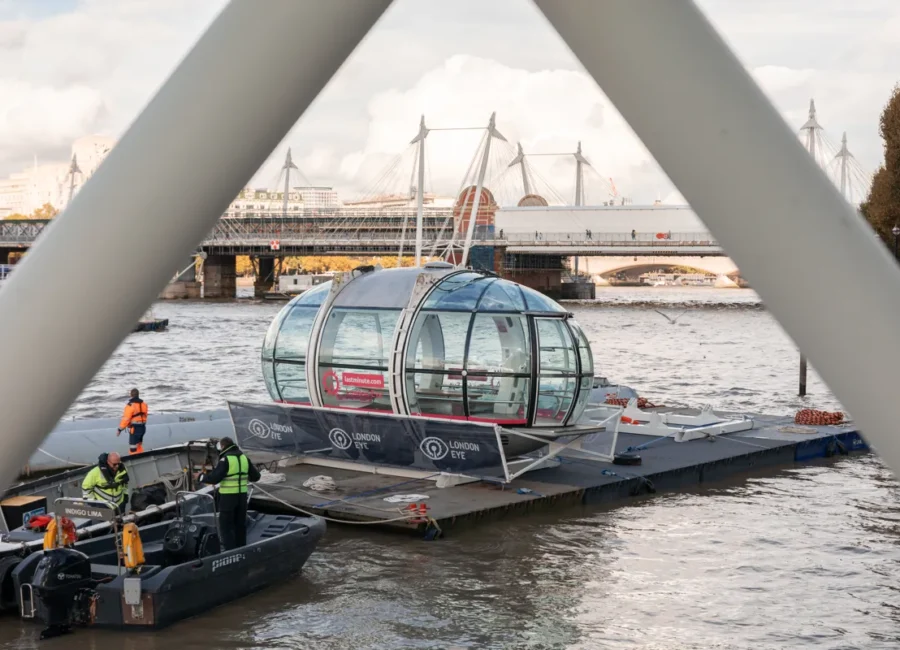
As part of the London Eye’s 25th anniversary upgrade, our modular steel pontoon systems were deployed to support the complex removal and transport of the attraction’s iconic capsules. Working on behalf of Livett’s, one of London’s most experienced marine operations specialists, this unique project took place in the heart of the capital, with the world watching.
A Floating Solution for an Iconic Landmark
The London Eye, standing 135 metres tall on the South Bank of the River Thames, is one of the most recognisable features of the London skyline. To mark 25 years of operation, the attraction is undergoing a comprehensive refurbishment — including the removal and upgrade of all 32 of its passenger capsules.
To achieve this, each 10-tonne capsule must be safely removed and transported down the River Thames. That’s where National Pontoon came in.
Our modular steel pontoons provided a safe, stable, and adaptable working platform for the capsule removal process. These pontoons were positioned directly on the Thames, adjacent to the London Eye, allowing specialist teams to load and secure the capsules for onward transit.
Partnering with Livett’s Marine
The project was delivered in close collaboration with Livett’s, a leading marine logistics company operating along the River Thames. With decades of experience in complex river operations, Livett’s were tasked with managing the capsule transport — and trusted National Pontoon to provide the floating infrastructure needed to get the job done.
You can find out more about Livett’s services at livetts.co.uk.
In the Spotlight: Featured in the Daily Mail
The high-profile nature of this project caught national media attention, including a full feature in the Daily Mail. With stunning visuals of the capsule being floated down the Thames, the article showcased the logistical scale and engineering precision required for such a delicate operation.
“It’s not every day that you see a capsule from Britain’s most recognisable attraction come floating down The Thames.”
— Stuart Watson, Director at UK Loco (the engineering firm now refurbishing the capsule)
Engineering Detail and Safety First
To execute this task safely and efficiently, our team worked closely with on-site engineers and marine coordinators. The pontoons were configured to accommodate:
- High point loads, including crane lifting operations
- Safe personnel access for the 12-member detachment team
- Secure tie-down areas for the capsule during loading and transit
- Environmental protection measures to minimise river impact
As always, our team provided full installation, certification, and safety documentation as part of the delivery.
Why Modular Steel Pontoons?
This project is a perfect example of why modular steel pontoons remain the go-to solution for complex infrastructure works. Their key benefits include:
- High load-bearing capacity for heavy plant, machinery, or structural loads
- Custom configuration to match unique environments like the River Thames
- Quick deployment and repositioning during multi-phase projects
- Enhanced safety and stability in tidal or fast-moving waters
Whether it’s supporting bridge repair works, event infrastructure, or cultural landmarks like the London Eye, our pontoons adapt to the task.
Keeping the Capital Moving
Even as the London Eye undergoes its renovation, the landmark remains operational. A temporary cage has replaced the first removed capsule, maintaining the structural integrity of the wheel. As capsules continue to be removed and refurbished, National Pontoon will remain ready to support with ongoing platform requirements along the Thames.
With a completion date set for early 2029, this project is a milestone in London’s modern history — and we’re proud to be playing a part in it.
Learn More About Our Infrastructure and Marine Capabilities
If you’re involved in a marine engineering, cultural landmark, or public infrastructure project, National Pontoon offers the trusted expertise and certified systems you need.
We work nationwide — from city centres like London to remote islands in the Scottish Highlands.
For more information, please visit our Commercial Pontoon Solutions page or Contact Us Directly.
Remote Plant Delivery by Pontoon at Loch Shiel
Remote Delivery Across Loch Shiel – Heavy Plant Moved by Modular Pontoon
This week, the National Pontoon team took on a unique logistics challenge in the heart of the Scottish Highlands — transporting heavy plant machinery to a remote, off-grid property accessible only by water.
The Challenge
The site, located on the banks of Loch Shiel, has no roads or tracks leading in. Traditional delivery methods weren’t an option. The only solution: float everything across.
Our client required a full fleet of equipment delivered to site, including machinery critical to the next phase of development.
The Solution
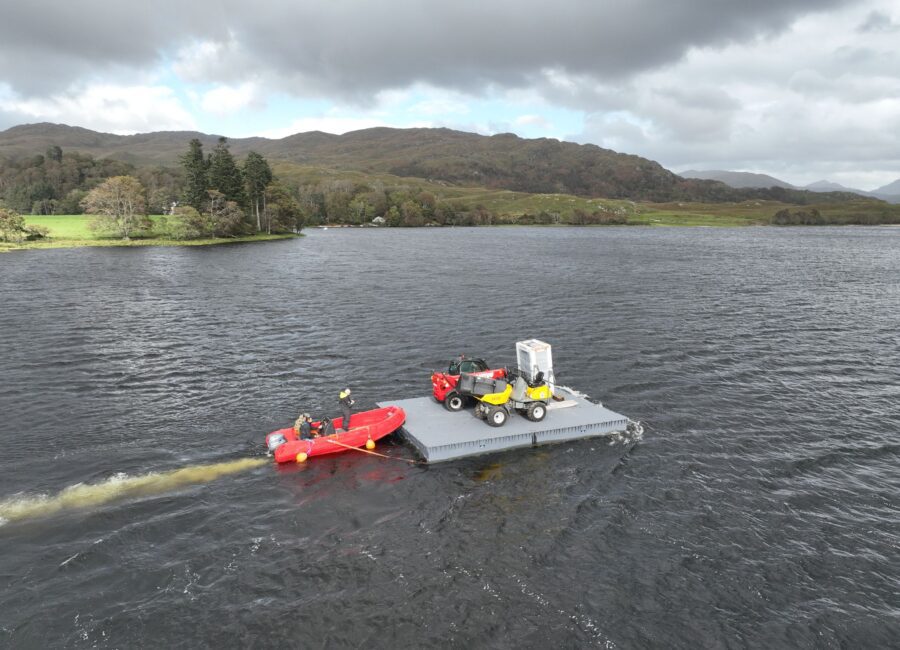
After a 7-hour journey north from Heysham, our operatives got to work assembling our NATO-spec steel modular pontoons and work boat directly on Loch Shiel.
From there, we executed a carefully planned multi-stage transport operation — safely moving plant equipment across the loch in a series of 2-mile crossings.
Over three trips, the following items were delivered:
- Excavator
- Telehandler
- Dumper
- Two shipping containers
- And a brand-new fridge (because even the Highlands need home comforts)
Safe Handling and Balanced Loads
Our pontoons were specifically configured to carry heavy plant equipment across open water. With each crossing, machinery was safely ramped on and off, with constant load monitoring to ensure safe, stable transit. Our crew on the water and on land worked together to manage load balance, vessel control, and dockside operations.
End to End Logistics
This wasn’t just a marine transport job. National Pontoon handled the entire logistics chain:
- Coordinated plant and container deliveries to our Heysham base
- Managed road transport north to Loch Shiel
- Carried out modular pontoon assembly and onsite delivery
- Ensured all equipment arrived safely, intact, and ready for use
The Outcome
Thanks to detailed planning, expert operations, and reliable equipment, our client’s remote property in Scotland is now fully stocked with the machinery required for future construction and development.
For more information, please click here to explore our commercial pontoon solutions or click here to contact us directly.
UKREiiF 2025: Floating Exhibition Pavilions Built by National Pontoon at Leeds Dock
National Pontoon Builds Floating Infrastructure for UKREiiF 2025 at Leeds Dock
National Pontoon is proud to be on-site in Leeds this week, supporting the build-up to UKREiiF 2025—one of the UK’s most important real estate and infrastructure events.
Running from 20th to 22nd May 2025, UKREiiF is set to welcome thousands of professionals from across the built environment, including developers, investors, local authorities, and occupiers. This year, the event is expanding in a bold and innovative way—onto the water.
A First for UKREiiF: Floating Exhibition Pavilions
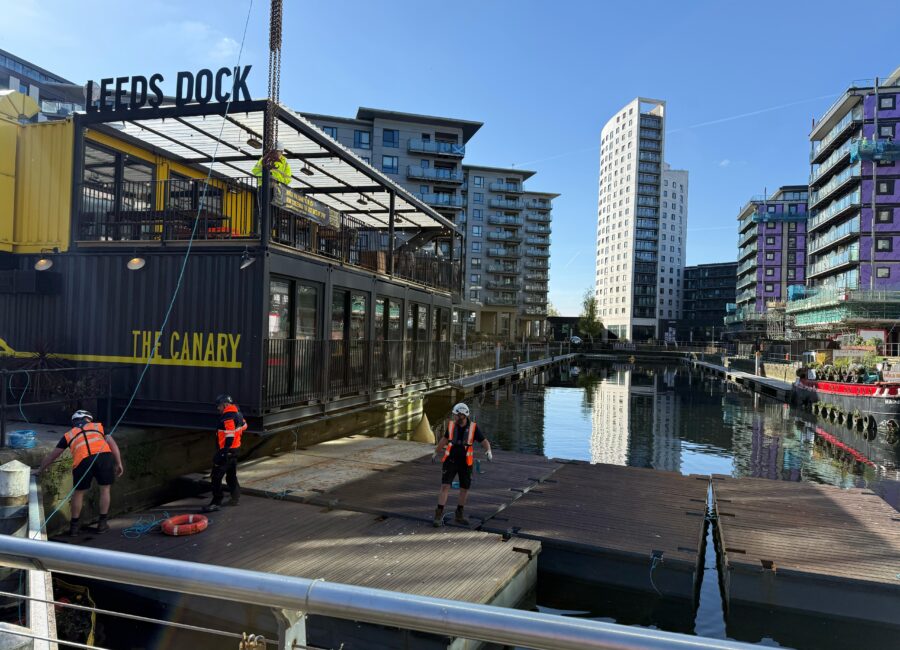
For the first time, UKREiiF is making use of the space on the water at Leeds Dock to host floating exhibition stands and pavilions. National Pontoon has been commissioned to deliver this ambitious aspect of the event—supplying and installing 120 floating pontoons to create a dynamic and visually impressive area right on the dock.
The pontoons will support a mix of branded pavilions and exhibitor spaces, directly connected to the main event site at the Royal Armouries Museum. Walkways, viewing areas, and safe, level access points are all being constructed by our team in preparation for the thousands of delegates expected over the three-day event.
Behind the Scenes: On the Ground (and Water) in Leeds
Work is well underway on site. Our team has been carefully manoeuvring each pontoon into position using telehandlers and cranes. Every section is checked and levelled before being joined to the wider structure.
Floating infrastructure of this scale doesn’t just appear overnight—it requires precise coordination, safe handling, and efficient installation. With Leeds Dock being a public waterfront area, we’ve worked closely with UKREiiF organisers and local partners to ensure minimal disruption and maximum safety.
Why Floating Platforms?
Using floating infrastructure allows UKREiiF to extend its footprint without needing permanent or invasive structures. It’s a smart use of urban space that aligns with the event’s focus on sustainability, regeneration, and future-facing design.
For exhibitors, these pontoons offer a high-profile location with excellent visibility and footfall. For visitors, it adds a new dimension to the UKREiiF experience—offering a unique setting that reflects the event’s ambition and scale.
Come and See It for Yourself
If you’re attending UKREiiF 2025, make sure to head down to Leeds Dock and explore the floating exhibition area. It’s not only a talking point—it’s a working example of how infrastructure can adapt, evolve, and support major events in innovative ways.
We’re proud to be part of this forward-thinking project and look forward to welcoming delegates onto the pontoons throughout the event.
Date: 20th – 22nd May 2025
Location: Royal Armouries Museum and Leeds Dock, Leeds City Centre